

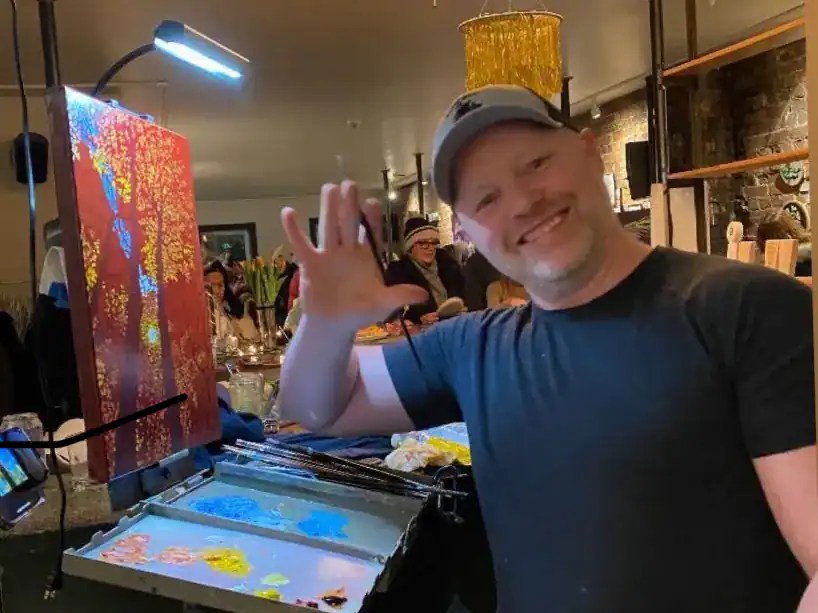

Rob C. Johns, Canadian
Oil Painter | Forest Ecologist
Artist Biography
I grew up in rural Ontario, spending my youth exploring the vast Boreal forest surrounding my home. Those early years sparked a lifelong fascination with nature that led to a PhD in biology, and eventually my current career as a forest ecologist with the Canadian Forest Service.
Although I have always dabbled in art, that interest took a back seat for decades as I pursued my scientific studies. That changed during the pandemic. Barred at the time from fieldwork, I set out to sharpen my scientific illustration skills to enhance my articles and talks. Over time that interest grew into oil painting of landscapes and wildlife, alongside my continuing research into forest insect outbreaks.
Straddling these two worlds sparked a deeper question about how they connect. For example, what does a painting do that a more conventional scientific illustration can’t? In my opinion, scientific illustration offers an efficient approach to explain complex concepts and anatomical details, but is ill suited to engaging viewers on a personal level. A painting invites someone to feel their way into it. Rather than explaining everything, a good painting leaves space for the viewer to bring something of their own life to the exchange. This idea still shapes how I paint.
My paintings have found collectors across North America, including the New Brunswick Museum. My work has been a top seller at Fredericton’s Capital Art Sale, and I’ve completed several residencies with regional museums. In May 2027 I’ll open my first solo exhibition, The Precarious Lives of Insects, at the Charlotte Street Arts Centre. In my scientific life, I’ve published over 50 research papers, received the national C. Gordon Hewitt Award for contributions to entomology, and currently serve as President of the Entomological Society of Canada.
I paint in Fredericton, New Brunswick, where I live with my wife and sons, two dogs, and a cat.
Artist Statement
I’m a forest ecologist, and what I’ve learned in 25 years of studying Canadian flora and fauna shapes what I see when I paint. The natural world is beautiful, but it is not gentle. For most creatures, survival means running a gauntlet of predators and disease, inclement weather, aggressive rivals, and picky mates. Even the food they eat fights back. Nature is a place of striving and resilience, where lives play out through periods of quiet repose punctuated by high-stakes moments of triumph and tragedy. These moments occur everywhere, at every scale, continuously, and usually without us noticing.
I paint nature the way our memories work, where important moments are preserved in more vivid and saturated detail than they held at the time. I use colour and light to sustain that intensity and to draw the eye to what matters most.
As a rule, I say little about the stakes or the biology behind a given painting. Explanation is the prerogative of good science. A good painting, to me, provokes curiosity while leaving much unexplained, leaving space for the viewer to explore, ponder, and sometimes find something that resonates with their own life and experience. My paintings are a reminder that, whether we witness them or not, the lives unfolding around us are as vivid, complex, and central to them as our own are to us.